Warning: Undefined array key "url" in /home/www/divi/wp-content/plugins/seo-by-rank-math/includes/modules/schema/snippets/class-author.php on line 41
There, Their or They’re—No More Tears!

There, Their or They’re—No More Tears!

There, Their or They’re—No More Tears!

Hello dear grammar enthusiast. Ever stare at a sentence and wonder, “There, Their, They’re… which one is it this time?”

Don’t worry, you’re not alone. These three little words can cause even the most confident writer to break into a cold sweat.

Look at this…

“You’re crafting a scathing (or hilarious) online review for a clothing store. There/Their/They’re selection of sweaters is amazing, but there/their/they’re all gigantic. There/Their/They’re I was, surrounded by racks of beautiful sweaters, yet none fit me properly—they all swallowed my petite frame.”

So how do you remember the difference?  Let’s have a look:

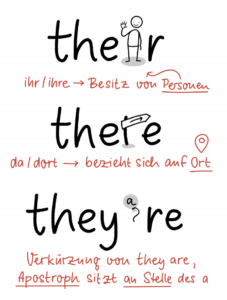
  • “Their” is for things that belong to someone, like “Their selection of sweaters is amazing!” 
  • “They’re” is a contraction for “they are,” like “They’re all gigantic!”
  • “There” is for places you can go, like “There I was…!” (Points dramatically in a random direction)

See? Easy, right? (Winks sarcastically)

Now go forth and conquer those pesky little words.

Still scratching your head? This little illustration might help you:A visual showing the difference between their, there and they're

Liebes Tagebuch 16

Liebes Tagebuch 16

Gestern war’s wieder soweit: Franz und ich waren mit Christine zusammen. Während Franz wie ein Vokabel-Ninja durch die Grammatik flitzte, kämpfte ich mit einem tückischen Verb: “to look“.

Franz, in bester Laune, verkündete: “I looked for my grandma yesterday.” Christine schaute ihn verdutzt an. War sie verwirrt oder spielte sie nur Komödie? “Hast du sie verloren?“, fragte sie besorgt.

Bäm! Da war es wieder – die tückische Präposition! Denn “to look” kann ganz schön vielseitig sein. Je nachdem, welches Wörtchen ihm folgt, ändert sich seine Bedeutung schlagartig.

To look for” bedeutet, nach etwas zu suchen. Zum Beispiel, wenn man verzweifelt nach den Schlüsseln sucht, die sich im Universum der verlorenen Gegenstände versteckt haben, oder die Polizei nach einem vermissten Jungen fahndet.

To look after” bedeutet hingegen, sich um jemanden oder etwas zu kümmern. So wie Oma, die sich liebevoll um die Enkel und den Hund kümmert, oder der Gärtner, der die Blumen im Park hegt und pflegt.

(Franz hätte also besser sagen müssen: “I looked after my grandma yesterday.”)

Ich gebe es zu: Diese “Phrasal verbs” bringen mich immer wieder ins Schwitzen. (Und ich bin nicht die einzige! Auch Franz kämpft mit ihnen.)

Aber hey, Übung macht den Meister. Deshalb habe ich mir einen Eselsbrücken-Tipp gebastelt:

Imagine you lost a puppy! You’d look for it everywhere, calling its name. But once you found it, you’d look after it, making sure it’s safe and happy.

Vielleicht klappt’s jetzt mit den “look“-Verben. Das werden wir sehen.

Eure Greta

The Secret to Giving Brain-Friendly Feedback

The Secret to Giving Brain-Friendly Feedback

Here’s a simple 4-step formula I learnt from Cognitive Psychologist, LeeAnn Renninger, to help us give clear, helpful feedback, without sounding critical.

Step 1: The Micro-Yes (Because Nobody Likes Surprises)

Start by asking a quick question to prepare the other person. This lets them know feedback is coming and gives them a chance to say yes or no.

Example:Do you have a minute to chat about the presentation?

This sets the pace and gets the other person involved from the beginning.

Step 2: Be Specific (No Blur Words!)

Skip vague words like “unprofessional” or “unorganised.” Instead, point out specific things you saw or heard.

Example:  In the presentation, some of the data wasn’t clear. Next time you could include charts to make it easier to understand.

Being specific helps the other person know exactly what to work on.

Step 3: Explain the Impact

Tell the person how their actions affected you. This helps them understand why the feedback matters.

Example:Because the data wasn’t clear, I wasn’t sure what conclusions to draw.

Explaining the impact creates a connection and makes the feedback more meaningful.

Step 4: Ask a Question

End with a question to involve the other person and turn it into a conversation.

Example:What do you think about using charts next time?

Asking a question encourages them to participate and find solutions together.

Bonus Tip: Ask for Feedback Too!

Great feedback givers also ask for feedback on themselves. This shows you’re open to learning and helps you improve.

Remember: Don’t wait for feedback to happen. Ask for it regularly!

Ready to put these tips into action? Try giving feedback using this formula today! You might be surprised at how well it goes.

It’s Put a Pillow on Your Fridge Day!

It’s Put a Pillow on Your Fridge Day!

Why in the world would anyone put a pillow on their fridge?

Well, hold on to your hats, because it’s actually quite a fascinating tradition. Putting a pillow on your fridge is believed to bring you good luck.

So, if you’ve got a spare pillow lying around, why not give it a shot? Just plop it on top of your fridge. And see what happens.

By doing this, you’re not just joining in the fun yourself; you’re also becoming part of a worldwide celebration. Right from the comfort of your kitchen. But let’s be honest, how many of us have ever done this before?

But, it’s not just about the act itself. It’s about the joy, the laughter, and the little bit of silliness it brings into our lives. Because, let’s face it, we all need a good giggle every now and then, don’t we?

So, here’s the plan: snap a selfie of your fridge with its new pillow on top and share it with me. Because being part of something bigger can make us feel extra special.

Now, the big question is: will you join in? Remember, it’s all in good fun. And who knows, you might just sprinkle some extra luck into your home.

Off you go now! Your fridge (and pillow) are waiting for you!

P.S. I have a built-in fridge, so I’ll be putting a pillow on my freezer. I hope the results will be the same! 😉

Have You Ever Been ‘Completely Carparked’?

Have You Ever Been ‘Completely Carparked’?

Or ‘absolutely wallpapered’ after a night out? 

If you’re scratching your head, let me explain. 

Brits have this knack for turning practically any word into a synonym for ‘drunk’—just by adding an ‘-ed’ to the end of it. (British comedian, Michael McIntyre explains in detail!) 

Very much like the Sámi people of northern Europe who have 300 words for snow, Brits have 546 words dedicated to being ‘plastered’, ‘sloshed’, ‘hammered’… All words explaining they’ve had one too many.

This hilarious tradition isn’t a joke—it’s backed by a study from Prof. Christina Sanchez-Stockhammer, who spent a year delving into the British love for booze (and words describing it).

She found out that this quirk is uniquely British—you wouldn’t find it in Germany, for example. 

So, we’ve seen how many words end in ‘-ed’,  but there are also exceptions. These include ‘legless’, ‘tipsy’, ‘merry’, ‘woozy’, ‘squiffy’‘tight’ and many more.

And why are there so many ways to say ‘drunk’?

It lets Brits talk about their drinking adventures with a bit of fun, ignoring the not-so-great parts of drinking too much.

So, cheers to Brits enjoying a pint and their clever way with words!