Warning: Undefined array key "url" in /home/www/divi/wp-content/plugins/seo-by-rank-math/includes/modules/schema/snippets/class-author.php on line 41

From Small Talk to Real Talk: The Shift That Changes Everything

From Small Talk to Real Talk: The Shift That Changes Everything

We’ve all heard the advice: “Just ask questions. People love talking about themselves.”

But here’s the truth: asking questions isn’t the same as having a conversation.

If your small talk feels like an interview — Where are you from? What do you do? — you’re collecting data, not building a relationship.

The real shift?

Slow down. Stay with one topic. Listen and respond with interest. That’s when small talk turns into real talk — and real trust.

💬 Next time you’re networking, will you run through a checklist or spark a genuine connection?
Are Your English Emails Stuck in the Dinosaur Age?

Are Your English Emails Stuck in the Dinosaur Age?

So many professionals still write as if business English has to sound stiff and formal:
“In response to your request…”
“Please do not hesitate to contact me…”

The result? Your emails sound like they were typed on a 1980s typewriter. 

But here’s the good news:
Modern business English has moved on.
It’s faster, clearer and much more human.

Try this instead:
“Thanks for your message.”
“Let me know if you have questions.”
“We’ve rescheduled the meeting.”

Shorter. Friendlier. Easier to read.

Because here’s the truth:
Most people don’t want flowery language. They want clarity.
It’s not about dumbing things down.
It’s about making your message clear and easy to grasp.

If your goal is to sound confident and up to date, strip out the fluff.
Write like a human, not like a machine.
And yes — even a smiley 😊 has its place.

👉 What old-fashioned English phrases are you ready to leave behind in your emails?

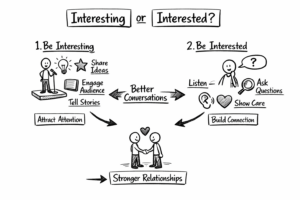
Interesting or Interested? — Sparks Plus, Week 6

Interesting or Interested? — Sparks Plus, Week 6

Interesting or Interested? — Sparks Plus, Week 6

Welcome to this week’s Sparks Plus — your quick, practical boost for clearer, more confident English.
Five short sections, all easy to read and use right away.


1️⃣ Quick Win

Interesting or interested?

  • Interesting describes the thing.
    This book is interesting.
  • Interested describes the person.
    I’m interested in this book.


2️⃣ Real-World English in Action

Denglish rescue:
A client said: We are 5 people in the meeting.

In English, we usually say:
There are 5 people in the meeting.
Five of us are in the meeting.


3️⃣ Christine’s Pick

Just in case you missed this:  10 English Pronunciation Errors German Speakers Make — a clear, practical guide to common mistakes and how to fix them.


4️⃣ Reader Question

Q: Can I say “He makes a wonderful job”?

A: In English, we say He does a wonderful job.
We “do” a job, not “make” one.


5️⃣ Spotlight

If you run workshops in English, here’s a handy resource for you.
My A–Z Glossary of English Terms for Workshop Tools & Supplies lists the words you need for everything from flipcharts to sticky dots — with both British and American terms where they differ.
Download it here.


So Much or So Many?

So Much or So Many?

When I work with more advanced English speakers, I notice something fascinating:

It’s not about the grammar rules. It’s not about the vocabulary. It’s not about the perfect sentence structure.

Just last week, a client stopped mid-sentence: “I have… so much… emails?

Here’s what’s interesting – she already knew the rule:

✅ “so much” for uncountable (water, time, money)
✅ “so many” for countable (emails, meetings, people)

But that pause wasn’t about grammar knowledge.

The real story?

She knew the answer. She’d learnt it years ago. What held her back wasn’t missing knowledge – it was missing confidence.

I see this pattern constantly. Professionals don’t need more rules. They need permission to trust their instincts.

Yes, remember “so many emails” is correct. But more importantly… stop letting these tiny doubts silence your voice. Your expertise matters more than whether you chose “much” or “many.”

Ready to break free from overthinking?

P.S. Which grammar rule makes you pause? 

Lost Your Words? You’re Not Alone

Lost Your Words? You’re Not Alone

Have you ever frozen during an important moment?

Last week, one of my clients shared a story that broke my heart. During an important job interview, when asked about her motivation for the position, she completely froze.

This happens more often than you think. In fact, I’ve seen it countless times:

  • Experts losing words mid-conversation
  • CEOs stumbling during presentations
  • Managers going blank in meetings

The truth is, English anxiety doesn’t discriminate. It hits everyone, regardless of their position or experience level.

But here’s what I’ve learned:

  • Everyone has been there
  • They’re opportunities for growth
  • These moments don’t define you

When my client came back for coaching, we worked on simple, powerful responses. We practised until she felt a lot more confident.

Two weeks later? The second interview? A completely different story. She got the job!

Why am I sharing this story with you? Because right now, someone reading this might be feeling the same way. Thinking they’re the only one struggling.

You’re not alone in this. Not at all.

Have you experienced anything similar? 

P.S. Remember: It’s not about never freezing – it’s about how you bounce back.