Why Do Migrants Have Smartphones?

Why Do Migrants Have Smartphones?

Why Do Migrants Have Smartphones?

Imagine you come across a group of migrants or refugees and notice that they all have smartphones.

Immediately, a question pops into your mind: “Why do they have these devices?”

It’s a question that often carries underlying biases and prejudices.

But here’s the thing: smartphones have actually become a lifeline for many migrants and refugees—an indispensable tool that helps them navigate through their challenging journeys.

Click here to watch a short video by the BBC that tackles this very question.

It takes us on an eye-opening journey, allowing us to experience the realities refugees face. It shines a light on why smartphones have become such a vital part of their lives.

We learn that smartphones are not just devices for social media or entertainment. They are lifelines connecting migrants and refugees to vital resources, information and loved ones left behind.

These phones help them navigate unfamiliar territories, access essential services and communicate with support networks.

This remarkable video is a powerful reminder that, as observers, we should question our initial assumptions and seek a deeper understanding.

The Battle for a Little Piece of England That Scotland Won

The Battle for a Little Piece of England That Scotland Won

The Battle for a Little Piece of England That Scotland Won

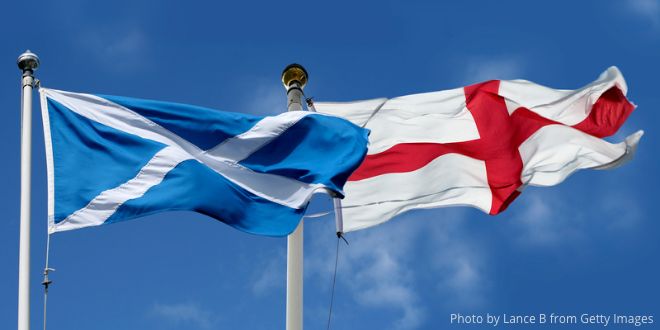
Discover the fascinating history of a little field that became a permanent part of Scotland because of a medieval football game. 

The small field known as Ba’ Green may seem insignificant, but it played an important role in shaping the borders of Scotland and England. 🌍

Back in the mediaeval times, the field was the prize in a game of “mob ball”, a brutal and exciting game played every New Year’s Day between two towns, Coldstream (Scotland) and Wark (England). 

However, as Coldstream grew much larger than Wark and there was no limit to the number of players, it won every time. 🥇

Eventually, the borders between Scotland and England were made official, and the Ba’ Green became a permanent part of Scotland. 🏴󠁧󠁢󠁳󠁣󠁴󠁿

This was fortunate for Scotland because mob ball was banned in England due to the game lasting for several days and keeping men away from important things like archery practice 🏹 and praying 🙏.

If you’re interested in learning more about the fascinating history between Scotland and England, be sure to explore further! 

How To Find a Wonderful Idea

How To Find a Wonderful Idea

How To Find a Wonderful Idea

If you’re looking for a captivating video, “How to find a wonderful idea” is definitely worth watching.

In this TED2017 video, you’ll get an inside look at the creative process that goes into making music videos for the band OK Go.

Whether you’re already a fan of their work or new to their music, this video is sure to be a treat that will leave you wanting more.

PS Look at the band’s website for more inspiration!

Videos To Spark Your Curiosity

Videos To Spark Your Curiosity

Videos To Spark Your Curiosity

TED-Ed has tons of short video lessons on a wide range of topics.

You can watch anything from “Why women’s clothing sizes don’t make sense” to “Are you a giver or taker“.

I was interested in learning “Why do airlines sell too many tickets?”  after having been denied boarding some years ago due to a lack of space on a plane to Malta.

Which video sparks your curiosity?

Do the British Say ‘Sorry’ More Often Than Others?

Do the British Say ‘Sorry’ More Often Than Others?

Do the British Say ‘Sorry’ More Often Than Others?

One study of more than 1,000 Brits found that the average person says ‘sorry’ around eight times per day.

If you find yourself saying ‘sorry’ all the time, even when it’s not your fault, you might be over-apologising.

Of course, apologising is not always a bad thing. It’s a nice way to show that you feel bad about something you did wrong.

But sometimes, we say ‘sorry’ too much.

It can make us seem unsure of ourselves and can make other people think we did something wrong when we didn’t.

A good way to stop over-apologising is to think before we say ‘sorry’.

We could ask ourselves if what we did was really something we should be ‘sorry’ for.

If the answer is no, then we don’t need to apologise.

So what can we do instead of saying we’re ‘sorry’ all the time?

We can change our language.

Instead of “Sorry I’m late“, we could say, “Thank you for waiting.” (This is polite and doesn’t make it seem as if we did something wrong.)

Instead of “Sorry for talking so much“, we could say, “Thank you for listening“.

And instead of “I’m sorry, I can’t come to your party“, an alternative could be “Thank you for thinking of me. Maybe next time.

Apologising is good when we’ve made a mistake. But over-apologising can make us feel worse instead of better. And it causes other people to see us as less competent and confident.

So let’s try and use some positive phrases instead.

PS If you’d like to read more, take a look at Inc.com’s article here